
A California startup is using fungal fermentation to transform low-value agricultural byproducts into more nutritious animal-feed ingredients, with the aim of reducing farmers’ feed costs by as much as 10%.
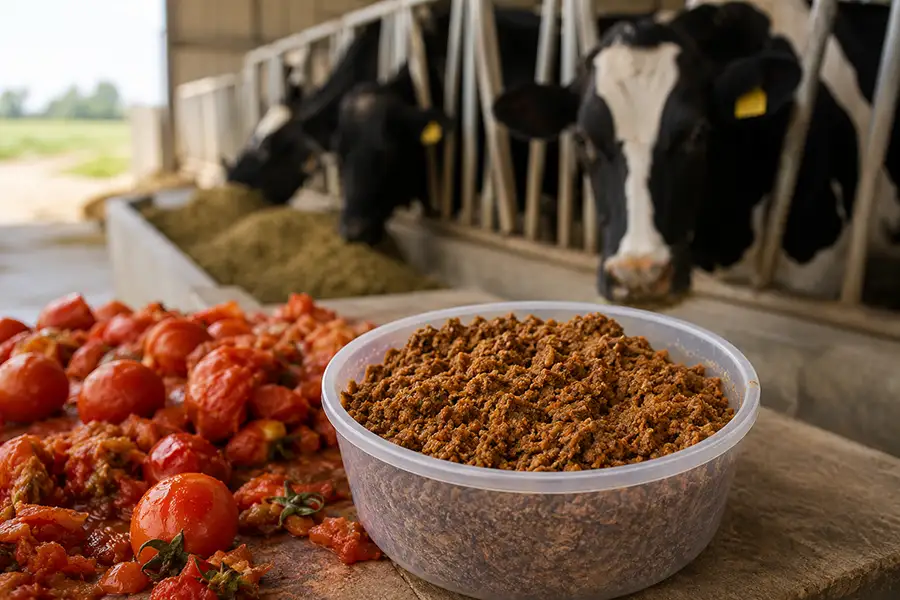
Gilly, an early-stage company backed by SOSV’s IndieBio programme, recently completed its first livestock feeding trial at Trinkler Dairy in Modesto, California. During the trial, 130 cows were fed a fungal-fermented ingredient made from tomato pomace, the skins and seeds left behind by the tomato-processing industry.
The company says its process can increase the crude protein content of agricultural side streams from approximately 15% to 23% in three days. It also aims to reduce compounds that can interfere with nutrient digestion.
The pilot is an intriguing example of how fermentation could move beyond producing finished foods and ingredients for people. It may also help farms extract more value from materials that already exist within the agricultural system.
Turning tomato waste into feed
Tomato pomace is produced when tomatoes are processed for products such as sauces, paste, and canned foods. It consists mainly of tomato skins, seeds, and remaining pulp.
The material is already used in some livestock-feed systems, but its nutritional value and practical use can be limited by moisture, variability, storage requirements, and relatively modest protein content.
Gilly’s approach is to use fungi to transform this material before it is blended into animal feed.
The company is also examining other agricultural side streams, including soybean hulls, almond hulls, and distillers’ grains from ethanol production. These materials are not necessarily waste in the strict sense, since many already have agricultural uses. However, fermentation may allow them to become more valuable and nutritionally concentrated ingredients.
This is an important distinction. The technology is not creating feed from nothing. It is attempting to improve materials already moving through the agricultural economy.
How the fungal fermentation works
Gilly uses a process known as solid-state fermentation.
In liquid fermentation, microorganisms grow in a liquid-filled tank. In solid-state fermentation, fungi grow directly across moist solid material containing little free-flowing water.
This resembles the broad biological principle behind foods such as koji, tempeh, and certain traditional fermented products, although the organism, substrate, equipment, and final purpose may be very different.
Gilly says it breeds proprietary, non-genetically modified strains of a fungus already associated with food production. The strains are selected to grow quickly and tolerate changes in temperature and acidity that could occur in agricultural environments.
According to the company, the fungi transform the feedstock in approximately three days.
During this process, fungal growth adds biomass and concentrates protein. The company reports that a starting material containing around 15% crude protein can reach approximately 23%.
However, crude protein is a broad measurement based largely on nitrogen content. It does not by itself reveal the complete nutritional quality, amino-acid balance, digestibility, or animal-performance value of the finished feed ingredient. Those questions require more detailed analysis and feeding studies.
What happens to anti-nutrients?
Gilly also says its fungal strains can break down compounds including phytates, tannins, lectins, and saponins.
These compounds are often described collectively as anti-nutrients because, under certain conditions and at particular concentrations, they can interfere with digestion or reduce the availability of some nutrients.
The term should be used carefully. Many of these compounds occur naturally in familiar foods and do not have a single effect in every diet, species, or processing environment.
For animal feed, however, reducing certain anti-nutritional compounds may improve how efficiently animals use a feed ingredient. Fungal fermentation has been investigated more broadly as a way to modify plant residues, reduce difficult-to-digest components, and concentrate protein.
The effect depends on the fungal species, substrate, fermentation conditions, and animal receiving the finished feed.
The first livestock trial
Gilly’s first reported livestock trial began in January 2026 at Trinkler Dairy in Modesto.
A group of 130 cows received feed containing fermented tomato pomace continuously for two weeks. The primary purpose was to test palatability: whether the cows would willingly consume the ingredient as part of their regular feed.
According to Gilly’s founders, the animals accepted and ate it successfully.
That may sound like a modest achievement, but it is an essential first step. An ingredient can have an impressive nutritional profile and still fail commercially if animals reject its taste, smell, or texture.
The trial did not, however, establish whether the ingredient improves milk yield, weight gain, feed-conversion efficiency, animal health, or long-term farm economics.
Those outcomes were not reported, and independent trial data have not yet been published.
Could it really cut feed costs by 10%?
Feed is one of the largest operating costs in livestock farming. Replacing part of an expensive protein ingredient with a lower-cost fermented byproduct could therefore make a meaningful difference.
Gilly estimates that its ingredient could reduce overall feed expenditure by approximately 5–10%. The company has also suggested potential savings of around US$0.50 per cow per day.
These figures remain company projections rather than independently verified results.
The final economics will depend on several factors:
- the local price and availability of agricultural side streams
- the cost of preparing and fermenting the material
- energy, labour, water, equipment, and quality-control requirements
- the nutritional consistency of the finished ingredient
- transport and storage costs
- the amount that can replace more expensive feed components
- the effect on animal performance
A process that works beside a California dairy using locally available tomato pomace may not produce the same economics in another region with different feedstocks, climate conditions, and farm infrastructure.
Bringing fermentation to the farm
One of the more unusual parts of Gilly’s plan is its proposed decentralised production model.
Instead of building only large central factories, the company wants to install fermentation modules close to farms or feedstock suppliers. Farms may already have handling equipment, storage capacity, labour, and access to the agricultural materials being transformed.
Gilly estimates that its first facility could be built for less than US$100,000. A module processing approximately 20,000 tonnes of material per year is projected by the company to generate around US$1.3 million in annual revenue.
These are ambitious early-stage projections. The first commercial facility has not yet demonstrated them at full scale.
Still, the model raises an interesting possibility: fermentation infrastructure that sits close to the source of the raw material rather than transporting bulky, low-value side streams across long distances.
Part of a wider fungal feed movement
Gilly is not alone in exploring fungi as a tool for animal nutrition.
Researchers and food-technology companies are investigating fungal fermentation for livestock feed, aquaculture, and pet food. Some approaches grow fungal biomass as the main protein ingredient. Others use fungi to transform agricultural residues or industrial side streams.
Finnish company Enifer, for example, is developing fungal mycoprotein ingredients for pet food and aquaculture using side streams from food and agricultural processing. Its technology is based on an industrial fermentation process originally developed in Finland decades ago.
The approaches differ, but they share a central idea: fungi can act as biological processing systems, converting inexpensive plant materials into ingredients with different nutritional and functional properties.
Fermentation beyond the human plate
For Brine & Bloom, this story offers a useful reminder that fermentation is much broader than the foods we prepare in jars.
In the home kitchen, microorganisms transform vegetables, grains, dairy, fruit, and drinks. In agriculture, related biological processes may be used to transform crop residues, improve feed ingredients, and create new production systems.
The scales and purposes are different, but the principle remains recognisable: microorganisms change the composition and usefulness of raw materials.
This does not mean every fermentation technology will prove economical or environmentally beneficial. Energy use, transport, equipment, feed safety, consistency, and actual animal outcomes all matter.
A circular process is only genuinely useful if it works reliably beyond the pilot stage.
What comes next for Gilly?
The January trial established that cows would eat the fermented tomato ingredient. The next questions are more demanding.
Gilly will need longer and more detailed trials measuring animal performance, nutritional consistency, feed conversion, and possible effects on milk production or weight gain. Independent evidence will be particularly important.
The company must also show that its three-day fermentation process can remain stable when handling large volumes of variable agricultural material outside the controlled conditions of a laboratory.
If the protein gains, feed-cost savings, and low construction costs can be reproduced at commercial scale, the approach could become an interesting addition to the expanding field of circular animal nutrition.
For now, Gilly represents a promising experiment rather than a finished transformation of the feed industry.
A modern agricultural problem
Fermentation has always been a way of making more from what is already available.
Gilly is applying that old biological principle to a modern agricultural problem: how to extract greater nutritional and economic value from the enormous streams of plant material left behind by food and crop processing.
The fungi may complete their work in just three days. Proving that the model works across farms, feedstocks, and seasons will take considerably longer.
Resources
MycoStories, Gilly Uses Fungal Fermentation to Cut Animal Feed Costs by Up to 10%
SOSV, Q&A: Gilly, A Better, Cheaper Animal Feed
Biofuels Digest, The Digest’s 2026 Multi-Slide Guide to Gilly Fungal Breeding
Fermentation Journal, Nutraceutical Enrichment of Animal Feed by Filamentous Fungi Fermentation
PMC, Fungi as a Source of Edible Proteins and Animal Feed
Enifer, Partnership to Produce Fungal Protein from Corn Ethanol Side Streams