
In the intriguing world of home fermentation, encountering different kinds of microbial activity is a common occurrence. Among these, kahm yeast often takes center stage, presenting itself as a thin white film on the surface of ferments, known technically as a pellicle. Despite its unappetizing appearance, it’s a frequent companion for fermentation enthusiasts and poses a frequently misunderstood phenomenon.
The term “kahm yeast” is widely used yet can be somewhat misleading. It denotes not just a single type of yeast but a collection of non-harmful, wild yeast species that can colonize ferments. While it can be mistaken for mold due to its appearance, kahm yeast isn’t necessarily a sign of spoilage. Understanding its role and impact on the fermentation process is crucial for both seasoned and novice fermenters to manage and ensure the success of their culinary projects.
Understanding kahm yeast
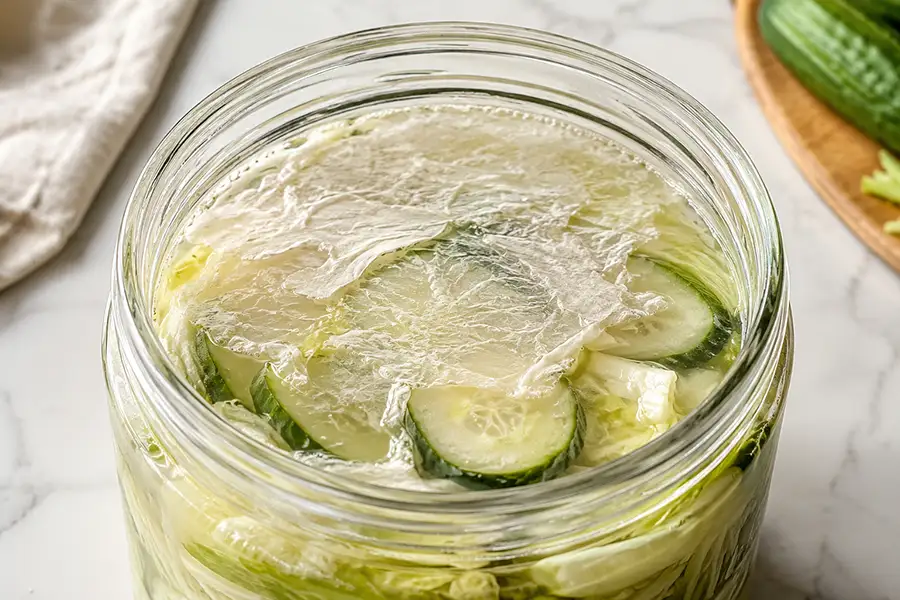
Kahm yeast manifests as a thin, white biofilm, or pellicle, that can cover the surface of your ferment. This film may appear lacey or wrinkly, and when disturbed, it can flake and disperse into smaller pieces, making it challenging to eliminate entirely. Meeting kahm yeast in your jar of ferment isn’t uncommon, especially given that it thrives in environments where the air exposure is consistent and surface tension is minimal.
The appearance of this yeast can be attributed to various species of wild yeasts such as Pichia and Candida. These yeasts are generally considered harmless but can alter the aesthetic and, sometimes, the sensory qualities of your ferments. It’s crucial to differentiate this from mold, as the latter could indicate potential spoilage and pose health risks.
While the pellicle’s physical characteristics can suggest the presence of kahm yeast, determining whether it’s problematic relies on additional factors. A pivotal aspect to evaluate is the aroma. If the ferment smells spoilage-free, kahm yeast presence might not necessitate immediate action. However, other indicators can sometimes point toward unwanted microbial growth, prompting a more cautious approach.
The role of yeasts and bacteria in fermentation
Fermentation is an ancient preservation technique driven by the action of yeast and bacteria, both of which play essential roles. In a balanced ferment, beneficial microbes break down sugars to preserve the food while maintaining or even enhancing its nutritional content. The presence of kahm yeast, therefore, is not inherently indicative of failure. Instead, it reflects the complex interplay of microbes that can occur in open fermentations.
Bacteria and yeast can both contribute to forming the pellicle seen with kahm yeast. However, it’s impossible to identify the specific microbes involved simply by observing the surface film. This microbial ambiguity means fermenters must rely on sensory evaluation—the smell, taste, and sight of the ferment—to judge its status. Good practice involves regular checking and maintaining optimal conditions to encourage beneficial fermenters over spoilage organisms.
When kahm yeast Is a concern
Despite its generally benign nature, kahm yeast can raise potential issues within the context of pH balance. The formation of kahm yeast can increase the pH of a ferment, potentially placing it into a range where spoilage organisms may thrive. A well-managed ferment typically aims to maintain an acidic pH, which acts as a natural preservative and inhibitor of spoilage and pathogenic microbes.
For individuals engaged in fermentation, recognizing when and if kahm yeast presents a genuine problem requires consistent monitoring of the fermentation environment. Should the sense of smell or visual cues raise alarms, such adjustments as reducing air exposure or reassessing salt concentrations might be necessary.
How to avoid it
What measures are effective in dealing with kahm yeast? Maintaining hygiene and environmental control is paramount. Ensuring that equipment is clean and that ferments remain submerged under their brine are fundamental steps. Additionally, opting for airlock systems or ensuring minimal air contact can reduce kahm yeast formation significantly.
If kahm yeast develops despite these precautions, removing the film can be a futile task given its persistence. Instead, focus on the holistic assessment of your ferment. Rely on sensory checkpoints like smell, appearance, and taste. If these remain normal, the ferment likely is unaffected by the yeast. In cases where kahm yeast is persistent, troubleshooting should include evaluating environmental factors and potentially adjusting recipes to prevent recurring issues.