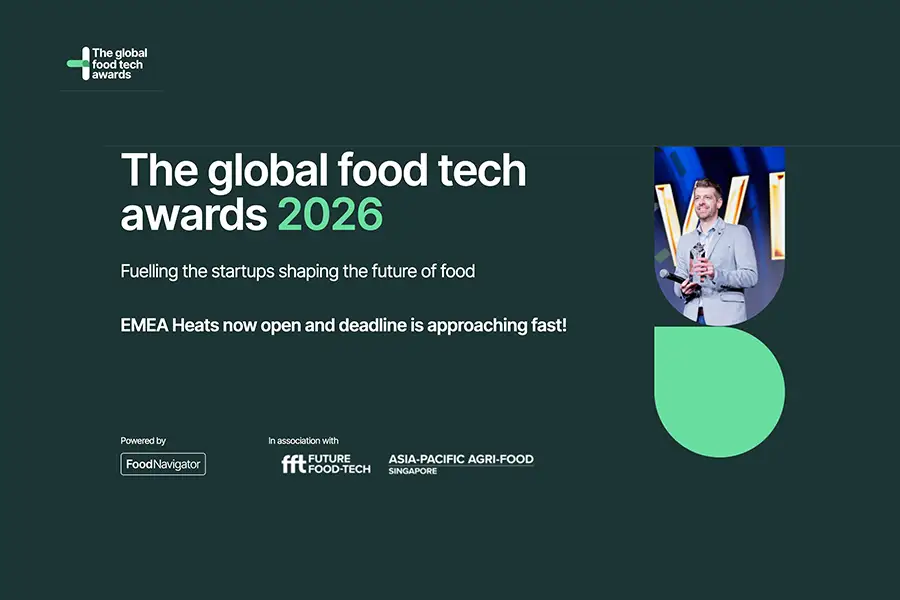

A new search is underway for early-stage companies developing technologies that could change how food is produced, processed, packaged, and brought to market.
Applications are now open for the Europe, Middle East and Africa heat of the 2026 Global Food Tech Awards. The competition is looking for young businesses working across the food and drink supply chain, from alternative ingredients and advanced fermentation to artificial intelligence, food-waste reduction, sustainable processing, personalised nutrition, and smarter packaging.
Entries are free, with applications closing on 20 July 2026. The EMEA regional winner will be announced at Future Food-Tech London on 24 and 25 September.
For fermentation-focused companies, the awards offer another sign that microbial processes are becoming increasingly visible within the wider food-innovation landscape. Fermentation is no longer discussed only in relation to yoghurt, sourdough, vegetables, beer, or traditional preservation. It now also appears in conversations about new proteins, natural colours, fats, flavours, agricultural resilience, and lower-impact ingredient production.
More than a novel idea
The awards are not simply seeking unusual concepts. According to FoodNavigator, the judges will examine whether a startup has developed a clearly differentiated solution to a real challenge within the food system.
Entries will be assessed across several connected areas: innovation, potential impact, technical strength, market understanding, commercial viability, and the ability to scale.
That distinction matters. Food technology is full of ambitious prototypes and compelling laboratory results, but moving from a promising idea to a product that can be manufactured reliably, approved by regulators, accepted by customers, and sold at a workable price is a much harder journey.
The strongest entrants will therefore need to explain not only what their technology can do, but why it is needed, who will use it, and how it could become commercially realistic.
Who can apply?
The EMEA heat is open to startups headquartered within Europe, the Middle East, or Africa.
To qualify, a company must:
- have been founded no more than five years ago
- employ fewer than 20 people
- have a finished product commercially available within the EMEA region
Eligible innovations can affect almost any part of the food and beverage value chain. The official awards material highlights areas including alternative proteins, sustainable ingredients, artificial intelligence, personalised nutrition, upcycled products, gut-health technologies, processing systems, and intelligent packaging.
Applicants are asked to submit information about their company and technology, together with a three-page pitch deck and a three-minute supporting video. The organisers state that businesses will not be required to disclose confidential formulas or proprietary information that is not already public.
From regional recognition to a global award
The Global Food Tech Awards are organised across three regional heats: the Americas, EMEA, and Asia-Pacific.
Ten startups are shortlisted in each region. From those ten, three finalists are selected to receive additional exposure at the relevant industry summit.
For the EMEA heat, the three finalists will receive branded exhibition space at Future Food-Tech London and additional promotional support through the event’s channels. The regional winner will be announced on stage and invited to present its work to food-industry leaders, investors, and potential commercial partners.
Shortlisted startups also remain eligible for the overall Global Food Tech Award, which is expected to be announced in December 2026 through a digital FoodNavigator feature.
The structure is designed to offer more than a trophy. For an early-stage business, contact with manufacturers, ingredient companies, investors, retailers, and prospective collaborators can be as important as the award itself.
Fermentation has already made its mark
Recent winners and finalists show how broadly food technology is now being interpreted.
The 2025 EMEA award went to Scottish biotechnology company BioMara, which develops ingredients from regeneratively cultivated seaweed. Its Seafibrex ingredient was recognised for combining functionality, nutrition, affordability, sustainability, and commercial potential.
One of the 2025 EMEA runners-up, Clean Food Group, uses non-genetically modified yeast fermentation and food-industry side streams to develop alternatives to conventional oils and fats, including ingredients intended to reduce dependence on palm oil.
Another runner-up, Kokomodo, uses cellular agriculture to produce cocoa ingredients designed to be less vulnerable to climate pressure and supply disruption.
Fermentation also appeared prominently in the 2026 Americas heat. The regional award went to Michroma, a biotechnology company using fungal fermentation to produce natural colours. Its platform aims to address some of the cost, consistency, supply, and performance difficulties associated with replacing synthetic food dyes.
These examples reveal an important shift. Modern food fermentation is increasingly being used as a manufacturing platform rather than only as a method for preserving or flavouring a finished food.
Microorganisms can be selected or cultivated to produce colours, proteins, fats, aromas, enzymes, and other ingredients. The vessel may be a stainless-steel bioreactor rather than a ceramic crock, but transformation through microbial activity remains at the centre of the process.
The scale-up question
Recognition can give a startup visibility, but awards do not remove the practical difficulties facing new food technologies.
Companies still need to prove that their processes can work reliably beyond laboratory or pilot scale. They may need regulatory approval, specialised production infrastructure, secure feedstocks, substantial investment, and evidence that customers genuinely want the finished product.
Taste and texture remain crucial. A technically impressive ingredient will struggle if it cannot perform in a familiar recipe, survive processing, meet pricing expectations, or fit naturally into the way people eat.
This may explain why the Global Food Tech Awards place so much emphasis on market knowledge and commercial viability. Innovation is only one piece of the puzzle. The technology must also answer a recognisable need.
A window into Europe’s changing food landscape
The EMEA competition arrives at a time when European food businesses are facing pressure from multiple directions.
Climate volatility is affecting crops and supply chains. Manufacturers are being asked to reduce waste, reformulate products, improve resilience, and respond to changing regulation. At the same time, investors have become more cautious, placing greater pressure on startups to demonstrate realistic economics rather than ambitious promises alone.
Against that background, the 2026 shortlist could provide a useful snapshot of which technologies are beginning to move from experimentation towards commercial application.
Some may focus on fermentation, cultivated ingredients, agricultural side streams, or alternative proteins. Others may approach the food system through artificial intelligence, packaging, manufacturing efficiency, or supply-chain technology.
The connecting question will be the same: can the innovation solve a meaningful problem in a way that can survive outside the laboratory?
Innovation
Food innovation is often presented through dramatic predictions about what we will eat in the future. The more revealing stories, however, may be found in the quieter work of improving ingredients, stabilising supply chains, reducing waste, and helping promising technologies reach practical scale.
The Global Food Tech Awards will not determine the future of food on their own. But the companies selected for the EMEA heat may offer an early look at the tools, organisms, materials, and ideas that are beginning to shape it.
Resources
FoodNavigator: Global Food Tech Awards EMEA Heat Opens
Global Food Tech Awards: How It Works
Global Food Tech Awards: Entry Requirements