

At Brine & Bloom, we talk a lot about fermentation as a living craft, a conversation between microbes and time. So when a French biotech startup announced it had raised fresh funding to grow milk proteins without a single cow involved, we paid attention. Not because it threatens the tradition we love, but because it might just save the parts of it worth keeping.
The company is Nutropy, based at Genopole outside Paris, and it recently closed a €7M funding round led by Big Pi Ventures and Zero Carbon Capital, with backing from Big Idea Ventures, Bpifrance and several others, including cheese producer Paul Dischamp. That brings its total funding past $10M since its founding in 2021 by CEO Nathalie Rolland and CSO Maya Bendifallah. The goal: bring an animal-free version of milk’s most important protein, casein, to market by 2027.
Why casein is the real challenge
Anyone who has tried to melt a slice of vegan cheese knows the problem. Plant-based alternatives can approximate flavour, but they rarely deliver the stretch, the meltability, the structural integrity that real cheese has. That’s because the proteins doing the real work, caseins, are missing.
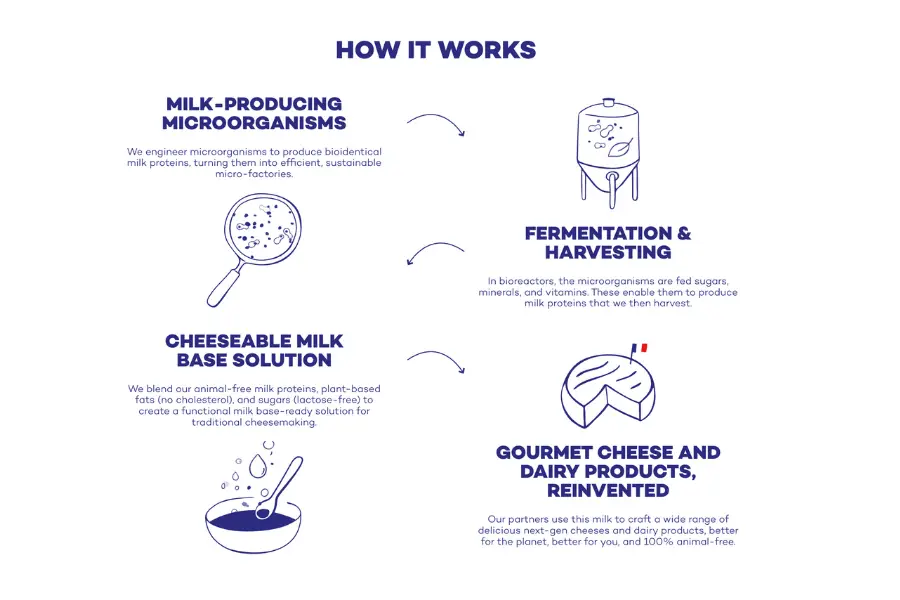
Caseins are the proteins in cow’s milk responsible for curd formation, fat stabilisation and the stretchy, gooey texture we associate with good cheese. Nutropy’s approach is precision fermentation: programming microorganisms in bioreactors, feeding them sugars, minerals and vitamins, and harvesting the casein proteins they produce. The proteins are bioidentical to the ones found in milk, meaning they behave the same way when a cheesemaker curdles them using their usual equipment. The company blends these harvested proteins with plant-based fats and lactose-free sugars into what it calls a “cheeseable milk” powder, a plug-and-play base that food producers can use much like conventional milk.
It’s a technique with real precedent. Precision fermentation is the same method used to produce insulin, and it already makes the rennet used to curdle roughly 80% of the world’s cheese. Nutropy is simply extending that same biotechnology to the proteins themselves.
A response to a shrinking dairy system
The timing is not incidental. Global milk shortages could reach 30 million tonnes by 2030, even as demand for dairy continues to climb and the number of working dairy farmers keeps falling. Nutropy is positioning itself to fill that widening gap, aiming for price parity with conventional cheese ingredients at launch, and targeting markets across North America, Europe, parts of Asia and the Middle East.
There’s also a waste argument worth sitting with. Conventional milk production generates whey sidestreams that dairies have to manage and process. Nutropy’s cheeseable milk, by contrast, is built only from the components needed for the final product, with nothing extra to offload.
The bigger picture: land, water and emissions
The sustainability case is substantial. Animal agriculture accounts for over 14% of global greenhouse gas emissions, and cheese sits among the most carbon-intensive foods produced anywhere. Dairy cows alone consume close to 5% of the world’s water and occupy a significant share of global farmland, land that could otherwise support biodiversity, food crops or simply be left alone. Removing the animal from the equation, even partially, chips away at that footprint in a way that plant-based cheese alternatives, which still lack casein’s functional properties, haven’t quite managed.
There’s a public health angle too. A fully animal-free process reduces the risk of zoonotic disease transmission and antimicrobial resistance, both of which are increasingly tied to industrial-scale animal farming.
And then there are the cows
We’d be doing this story a disservice if we stopped at emissions and efficiency, because behind every litre of milk is an animal, and the modern dairy industry is not gentle. Dairy cows are kept in a near-constant cycle of pregnancy and lactation to keep milk flowing. Calves are typically separated from their mothers within a day or two of birth, a practice that causes visible distress in both, so that the milk meant for the calf can be sold instead. Male calves, who will never produce milk, are frequently considered a byproduct of the system, often raised for veal or slaughtered shortly after birth. Cows themselves are usually sent to slaughter within a few years once milk yields decline, despite a natural lifespan that stretches to twenty years or more.
None of this is exotic cruelty hidden in a few bad operations. It is largely how the conventional dairy system is built to run, everywhere, at scale, because it is efficient. That’s precisely why technologies like Nutropy’s matter beyond the environmental spreadsheet. A cheese that tastes and melts like the real thing, made without a mother cow and her calf ever entering the picture, is a genuine ethical offering, not just a sustainability one.
We ferment because we believe in transformation without shortcuts, sugars into acids, milk into cheese, time into flavour. Precision fermentation asks a different but related question: can we keep the transformation and let go of the harm that used to come bundled with it? Nutropy, and the growing field around it, suggests the answer might soon be yes.
Try this: Beginner’s Guide to Fermentation
Sources: STARTUPPER, Nutropy