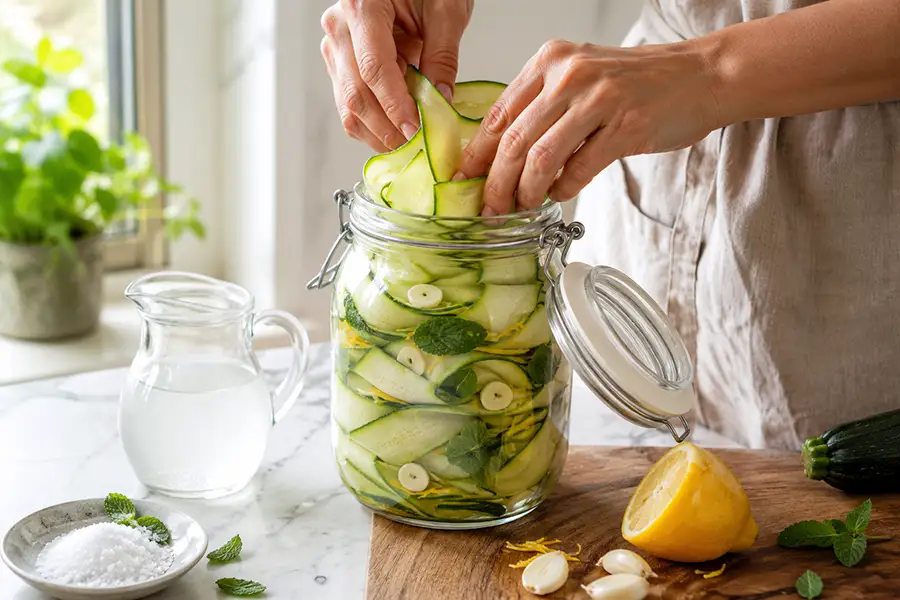
Courgette ribbons are delicate, quick to prepare, and best treated as a short ferment. Thin strips of courgette are layered with garlic, mint, and lemon zest, then covered with a light salt brine until they become gently tangy and aromatic.
This is not a long, deeply sour ferment. Courgettes have a soft structure and high water content, so they can lose texture quickly if left too long at room temperature. The goal here is freshness: a brief fermentation that keeps the ribbons bright, flexible, and useful for summer plates.
Mint brings a cooling herbal note, garlic adds depth, and lemon zest lifts the whole jar without making it taste sharp or heavy.
Why you’ll love this ferment
This is a light, elegant courgette ferment for warm-weather meals. The ribbons are soft but still fresh, with a gentle briny tang and a clean herbal aroma.
They work beautifully with yoghurt, grilled vegetables, flatbreads, rice bowls, lentils, chickpeas, eggs, or mezze-style plates. They can also be served as a small side dish with olive oil and extra herbs.
FAQs
How long should I ferment courgette ribbons?
Courgette ribbons need only a short ferment, usually 12–36 hours. Thin ribbons soften quickly, especially in warm weather, so taste early and refrigerate once lightly tangy.
Can I use large courgettes?
Yes, but smaller firm courgettes give a better texture. If using large courgettes, avoid the soft seedy centre and use the firmer outer flesh for ribbons.
Can I add lemon juice instead of lemon zest?
Lemon zest is better during fermentation because it adds aroma without making the brine too sharp. If you want more brightness, add a little lemon juice after fermentation, just before serving.
Courgette Ribbons in Brine
Ingredients:
For 1 medium jar:
- 500 g firm courgettes
- 1 garlic clove, thinly sliced
- 6–8 fresh mint leaves
- Zest of ½ unwaxed lemon
- 500 ml water
- 10–15 g fine sea salt or pickling salt
Brine Ratio
For a very light short ferment:
- 2% brine: 10 g salt per 500 ml water
For a slightly firmer result:
- 3% brine: 15 g salt per 500 ml water
Use 3% if your kitchen is warm or if your courgettes are especially tender.
Directions:
- Wash the courgettes well and trim the ends.
- Use a vegetable peeler or mandoline to cut the courgettes into long, thin ribbons. Avoid the very soft, seedy core if the courgettes are large.
- Place the garlic, mint, and lemon zest in a clean jar.
- Add the courgette ribbons gently, folding them into the jar without crushing them.
- Dissolve the salt fully in the water to make the brine.
- Pour the brine over the courgette ribbons until they are fully covered.
- Use a fermentation weight or suitable clean food-safe weight to keep the ribbons below the brine. Thin ribbons float easily, so check carefully.
- Close the jar loosely, or use a fermentation lid. Place the jar on a small plate.
- Ferment at room temperature for 12–36 hours. In a warm kitchen, taste after 12–18 hours.
- When the ribbons taste lightly tangy and still fresh, transfer the jar to the fridge.
What to Expect
The courgette ribbons will soften slightly and absorb the flavour of the garlic, mint, and lemon zest. The brine may become lightly cloudy.
The finished ferment should smell fresh, herbal, garlicky, and gently sour. Discard it if you see mould, sliminess, unpleasant odours, or signs of spoilage.
Fermentation Time
12–36 hours at room temperature.
This is intentionally a very short ferment.
Notes:
Storage
Store in the fridge and use within 5–7 days for best texture.
Always use clean utensils and keep the ribbons below the brine.
Serving Ideas
Serve with yoghurt, labneh, sour cream, or coconut yoghurt herb sauce.
Add to grain bowls with lentils, rice, chickpeas, herbs, and roasted vegetables.
Layer into flatbreads, wraps, or mezze plates.
Drain lightly and dress with olive oil, extra lemon zest, and fresh mint just before serving.